The Ship Never Moves
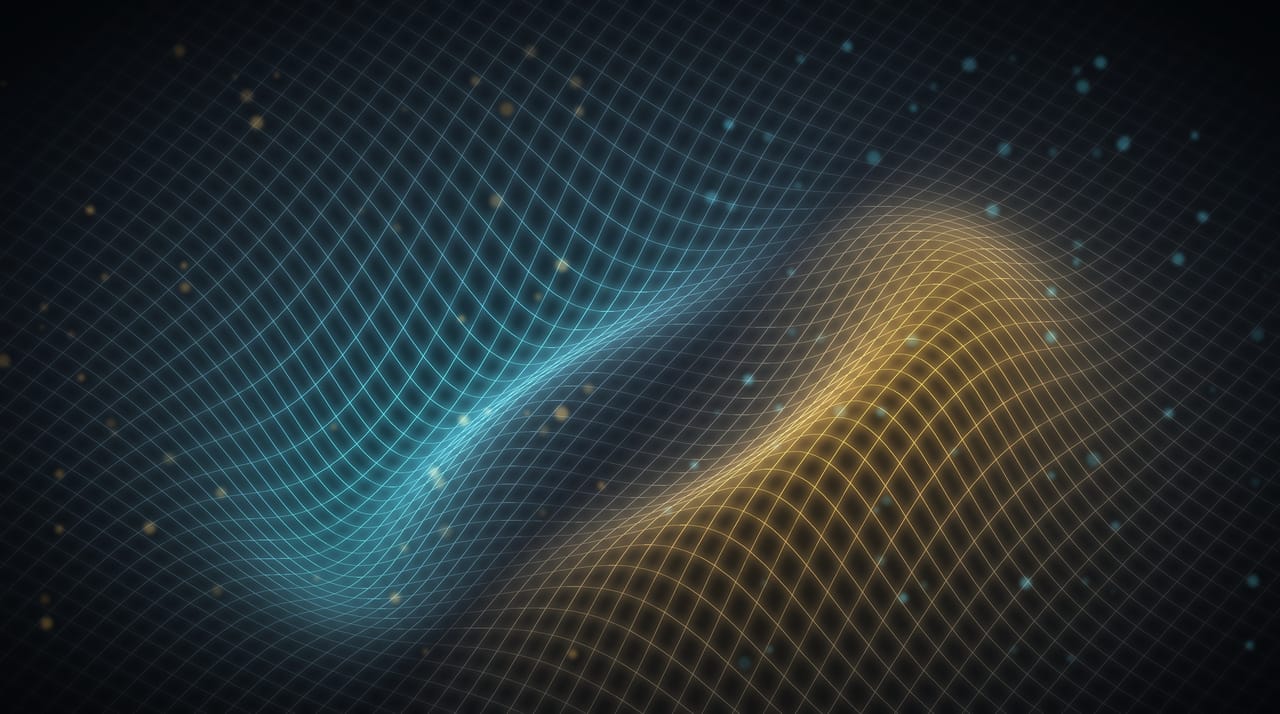
In Miguel Alcubierre’s 1994 warp-drive solution, the ship never moves. Space moves around it. I built a 3D model of the metric to see it, and the object that mattered turned out to be a slider I could not push far enough: the one that sets how thin the bubble wall has to be.
That slider is a better frame than I went looking for. The usual question about machine intelligence is how many years until AI delivers X. The useful question is what is stopping X, and whether intelligence was ever in the way.
What moves is the geometry
The ship sits in a pocket of flat spacetime, follows a geodesic, and feels zero acceleration. Its clocks tick at the same rate as everyone else’s. Nothing inside the bubble travels faster than light through space, because nothing inside the bubble travels at all. What moves is the geometry: space contracts ahead and expands behind, and the bubble surfs the deformation. The crew are passengers on a wave, not occupants of a vehicle.
Every illustration I could find gets that wrong: search for “warp drive” and you get a saucer inside a glowing blue ellipsoid, a picture of a fast ship, which is what this isn’t. Alcubierre’s five-page letter in Classical and Quantum Gravity asks what general relativity would have to look like for the Star Trek version to be true, and the answer is stranger than the fiction. So I built it.
What the model draws
All of the physics lives in one function: a shape function f that equals 1 inside the bubble and 0 outside, with a transition shell between them. Everything interesting — all the curvature, all the exotic matter, all the trouble — is in that shell.
The quantity worth drawing is the expansion scalar, negative ahead of the bubble and positive behind it. So rather than model a ship and a glow, I displaced a grid of spacetime by that value: a trough ahead, a crest behind, a dead-flat plateau in between where the ship sits. The plateau isn’t an artistic choice — inside the bubble f is constant, so its gradient vanishes. Amber and cyan aren’t decoration: they’re a divergent colormap on the sign of the expansion.
Drag the wall-steepness slider and the shell narrows. What you are watching is the constraint that makes this impossible. The original solution wants the wall about 10⁻³² meters thick, near the Planck length, where describing geometry classically stops meaning anything. The readout tells you how far off you are: even at the slider’s maximum, roughly 32 orders of magnitude too thick. It’s one thing to read that number. It’s another to be unable to move it.
The model is below. Push σ until the wall gets thin. It needs about 590 KB of three.js on a site whose whole premise is shipping almost no JavaScript, so it sits behind a button; the 2D cross-section works either way.
Alcubierre warp bubble
The 3D surface needs three.js — about 590 KB. Nothing loads until you ask for it, so the cross-section below works either way.
Cross-section at y = 0
- Wall thickness, 100 m bubble
- 22.73 m
- Thickness / radius
- 0.2273
- Gap to the required 10−32 m
- 10^33 too thick
The number behind the slider
There is no experiment, at any budget. Pfenning and Ford worked through the quantum inequalities in 1997 and found they pin the bubble wall to roughly a hundred Planck lengths — the constraint you can feel in the slider. Propagate that through and a hundred-meter bubble needs about −1.1 × 10⁶⁷ grams of negative energy: roughly ten orders of magnitude past the mass of the visible universe, and the minus sign is not a typo. Break the wall-thickness rule illegally and you still need something like six solar masses of a substance nobody has ever produced.
The thing being tested isn’t a number we haven’t measured. It’s a substance that may not be permitted.
Mathematics fell first because it needed no apparatus
Last week, an AI system appears to have closed the Navier–Stokes Millennium Prize problem. Two hundred years of mathematicians failing to determine whether the equations governing fluid motion always behave, and the answer looks to be that they do not — solutions can blow up. Mathematicians directed the models, the strategy was human, and the proof was formally verified in Lean. The field is still sorting out what it means, and there’s an ugly credit fight attached that I’ll leave alone — except to note that Lean does not care who wrote the proof, a defense no other discipline has.
The result required no apparatus: no materials, no reactor, no cleanroom, no ethics board, no energy budget beyond electricity. The entire research loop fit inside a computer, because the object of study was made of symbols.
That is why mathematics fell first. It tells you almost nothing about anything else.
Intelligence was never the scarce input
We have known exactly how to make antimatter since 1955; the limit has never been ignorance. CERN’s own number ended the argument for me: take the lab’s entire annual antiproton production, trap all of it, annihilate it at once, and you get about 500 joules. A hundred-watt bulb for five seconds. That’s a thermodynamics problem, and a machine a thousand times smarter than every physicist alive could improve the yield by orders of magnitude and still leave you astronomically short of a fuel supply.
Fusion is the same shape with a longer runway. The physics was settled in the 1930s, and it took ninety years of engineering to get more energy out of the target than the lasers put in — 2.05 megajoules in, 3.15 out, in December 2022, with the record now at 8.6 megajoules. Target gain politely ignores the far larger draw from the grid required to fire those lasers. The constraint was never the idea.
AlphaFold is the case that should worry the optimists, because it’s the success story. Protein structure prediction was a knowledge bottleneck, it collapsed, and there are now over 214 million predicted structures in a public database. Then what? Drugs still take about a decade to reach patients. The bottleneck didn’t disappear, it was hiding behind the one we solved — and it turned out to be human biology and elapsed calendar time, which don’t respond to intelligence at all.
Solve the computational step, expose the physical one. I wrote almost exactly this about agents two days ago without noticing it was the same shape: the loop commoditizes, the constraint moves to whatever contains it. It generalizes further than I thought.
Theory debt
The cheap side of science just got a large multiplier and the expensive side did not, so the gap between what we can derive and what we can confirm widens rather than closes. What accumulates is a pile of results that are probably true and nobody can afford to test.
Everyone in my line of work understands technical debt: you take a shortcut, you ship, and you pay interest later on a foundation nobody validated. Run the same play at the scale of human knowledge and I don’t have a better name for it than theory debt. The interest gets paid the way it always does, in the things we build on the parts nobody checked. I spent three years failing to fix a pipeline before working out that the constraint was never where I kept looking. Same mistake, bigger scale.
I don’t think this is avoidable and I’m not sure it’s even bad. But it’s a different future than the one where the singularity arrives and suddenly we have cures, immortality, and drives that fold space. That scenario assumes the physical constraints were soft all along and waiting on someone clever. There’s no evidence for that and a great deal against it.
Sort your own
Test the argument against your own intuition instead of reading mine. Eight technologies. For each, guess what’s in the way — knowledge, energy, matter, or time — then see the measured number. The payoff is the board at the end, where all eight sort into columns and the shape becomes obvious.
I got two wrong, and I’d just finished writing the post.
Interactive · Eight cases
Intelligence is getting cheap very fast. Energy and matter are not. For each of these, guess what is actually in the way — then see the measured number.
Case 01
Prove whether the Navier–Stokes equations always have smooth solutions
What is the binding constraint?
Where the optimistic story is true
The fast scenario is real in one place: where the manufacturing substrate already exists. You don’t have to build a fab to make a protein — evolution built one, and you’re programming it. Same for materials: the experiments are small, cheap, and run in parallel, and self-driving labs, which run thousands of them without a human choosing the next one, are real and funded. That isn’t breaking physics. It’s running the search faster — a speedup bounded by how long one experiment takes, but a real one.
If you want a case to watch, it isn’t a warp drive. It’s a room-temperature, ambient-pressure superconductor. Nothing forbids one, the search space is combinatorial, and the experiments are cheap — exactly the shape of problem this technology is good at. It would change more about how the world works than most of the things people file under fantasy.
What the fiction gets right
Project Hail Mary grants exactly one miracle and puts it in the right place. Astrophage is usually described as an organic substance that produces propulsion when you shine light on it. That’s not what it does, and the difference is the point. Astrophage stores stellar energy at near-perfect mass-energy density and re-emits it as infrared: storage plus a photon drive. Photon drives are legal physics — the problem has always been that thrust-to-power is miserable. Weir identified the bottleneck, energy storage density, and granted one miracle against it. The warp bubble does the opposite. It grants a miracle that everything else depends on.
Peter F. Hamilton and Alastair Reynolds are the two opposite answers to the same question. Hamilton grants FTL and writes the infrastructure around it: the Commonwealth’s defining move is that faster-than-light travel isn’t a ship, it’s a fixed wormhole with trains running through it. Rights of way, capacity, gateway politics. A network topology story wearing a starship costume, which probably explains the appeal for me.
Reynolds refuses FTL outright and writes the society that falls out of the constraint. He’s an actual astrophysicist, and Revelation Space is rigorously sublight: lighthuggers, time dilation, crews who outlive the civilizations that launched them. Nothing in it violates a conservation law, and it’s richer for the constraint.
If the machine-accelerated theory work lands where I think it lands — a no-go theorem on macroscopic energy-condition violation rather than a drive — then we live in Reynolds’ universe and not Hamilton’s. Sublight, dilated, expensive, slow. I’ve made my peace with this. Revelation Space is terrifying, but it’s reachable.
So when do we drop the “A”?
Never, and also constantly.
“Artificial” describes provenance, not capability. We don’t drop it from “artificial light” because the bulb works. What happens instead is the AI effect, running since the 1960s: once something works reliably, we stop calling it AI and call it the thing it does. Nobody calls a spam filter or a chess engine AI anymore. The term keeps retreating to mean whatever hasn’t worked yet, and it’ll still be doing that in fifty years.
“How many years until AI delivers X” is the wrong shape of question, because X isn’t one thing. Sort your X’s by what’s stopping them. The ones stopped by not knowing are going to move startlingly fast. The ones stopped by joules, grams, and elapsed years will move at the speed they always have — and the loudest predictions are the ones that never checked which column they were in. Alignment, it turns out, sits in the first column, which is better news than it sounds and harder than it sounds.
Appendix: the failures with no error message
The division of labor was the one I keep landing on: I brought the question, the science fiction, and the calls about what stayed in. Claude brought retrieval, the figures, and a first draft. Two things went quietly wrong, one mine and one the model’s, and they’re the same species.
Mine. The first version of the visualization rendered nothing. No console error, no failed assertion, no red text — just an empty box where a universe should be. I’d loaded three.js from a CDN at three.js/0.128.0/three.min.js; the correct path is three.js/r128/three.min.js. A script tag that 404s doesn’t throw anything you’ll notice: it silently doesn’t exist, and every line that depended on it quietly does nothing. I caught it by serving the file over local HTTP and looking at the rendered page with my own eyes. Porting it here produced the same failure from the opposite direction: this site’s Content Security Policy is script-src 'self', so any CDN is blocked outright and fails silently in the same shape. Three.js is vendored locally now.
The model’s. Asked for the energy requirement of a warp bubble, Claude gave me a figure from memory — around ten billion solar masses — and flagged it as recalled rather than looked up, which I appreciated. When it pulled the Pfenning and Ford paper, the real number was the −1.1 × 10⁶⁷ grams above. The remembered figure wasn’t merely wrong. It was wrong in the flattering direction: it made the warp drive sound more plausible than the literature does. It also told me Morris and Thorne published three years before Alcubierre. It’s six.
Neither error was caught by the model being smarter. Both were caught by opening the primary source and comparing, which is what I found looking at where augmentation pays off. Code and claims that generate confidently and fail quietly are the same hazard, and the only antidote is looking at the output instead of the diff.
Here’s the meter for the writing half:
Total cost:            $6.49
Total duration (API):  11m 56s
Total duration (wall): 30m 8s
Total code changes:    623 lines added, 2 lines removed

Usage by model:
  claude-opus-5:    1.1k input, 49.4k output, 5.5m cache read, 247.3k cache write ($6.44)
  claude-haiku-4-5: 45.0k input, 1.4k output, 0 cache read, 0 cache write ($0.0520)

Prompt cache (main): 26 requests · 95% of input tokens from cache · no misses · warm
That is what it cost to produce and verify a couple thousand words and one small app. Scale it honestly against the volume of claims this technology can generate when nobody’s checking, and you have the argument of this post as a single line item.
Resources
- Alcubierre, “The warp drive: hyper-fast travel within general relativity” (1994): https://iopscience.iop.org/article/10.1088/0264-9381/11/5/001
- Pfenning & Ford, “The unphysical nature of ‘warp drive’” (1997): https://arxiv.org/abs/gr-qc/9702026
- AI has solved one of math’s $1 million Millennium Prize problems — Quanta Magazine: https://www.quantamagazine.org/ai-has-solved-one-of-maths-1-million-millennium-prize-problems-20260908/
- AI may have just solved a million-dollar math problem — Scientific American: https://www.scientificamerican.com/article/ai-may-have-just-solved-a-million-dollar-math-problem-the-field-will-never-be-the-same/
- CERN on antimatter production: https://home.cern/science/physics/antimatter
- Achieving fusion ignition — Lawrence Livermore National Laboratory: https://lasers.llnl.gov/science/achieving-fusion-ignition
- AlphaFold Protein Structure Database, Nucleic Acids Research (2024): https://academic.oup.com/nar/article/52/D1/D368/7337620
- Constant velocity physical warp drive solution — Classical and Quantum Gravity (2024): https://iopscience.iop.org/article/10.1088/1361-6382/ad26aa
- Warp Factory, the open-source numerical GR toolkit: https://appliedphysics.org/warp-drive/

About the Author
Kevin P. Davison has over 20 years of experience building websites and figuring out how to make large-scale web projects actually work. He writes about technology, AI, leadership lessons learned the hard way, and whatever else catches his attention—travel stories, weekend adventures in the Pacific Northwest like snorkeling in Puget Sound, or the occasional rabbit hole he couldn't resist.